
Free Tool · Amarillo, TX
Dumpster Size Calculator — Which Size Do I Need in Amarillo?
Answer two quick questions and get the same size our team would recommend on the phone — then check it against your debris, weight, and driveway below.
Answer two quick questions and get the same size our team would recommend on the phone — then check it against your debris, weight, and driveway below.
What size dumpster do you need? Pick your project below and this Amarillo dumpster size calculator gives you an answer in about 10 seconds — the same questions we ask on every booking call. Then scroll down to double-check it against your debris, its weight, and your driveway.
This covers most residential and contractor projects. For mixed loads or unusually heavy debris, call and we’ll confirm the right size before delivery day — then see our delivery prep checklist.
Calculating your size…
Project type is the best single clue to the right size — better than guessing at “how much junk I have.” The calculator starts there, then adjusts for how full you expect it to get and whether heavy debris is going in. Heavy loads like concrete, dirt, caliche, brick, or shingles change the answer, because they hit the weight limit long before the container looks full. Want the actual weight of a heavy load, not just a size? Use the material weight calculator on our weight limits page.
Quick Reference
Single room, garage, or fence job
Small cleanouts & light yard work
Roof tear-off or estate cleanout
A common starting point for Amarillo jobs
Full roof replacement or multi-room remodel
Heavy renovation waste
New construction or whole-house demolition
Major builds & full tear-downs
Large commercial demolition or land clearing
Industrial-scale & site clearance
“Nine times out of ten, the person calling already has the right instinct — they just don’t trust it yet. If you can look at your project and say ‘that’s about three truckloads,’ you’re closer to the right size than you think. My job on the phone is usually just confirming what you already know, not overselling you a bigger box.”
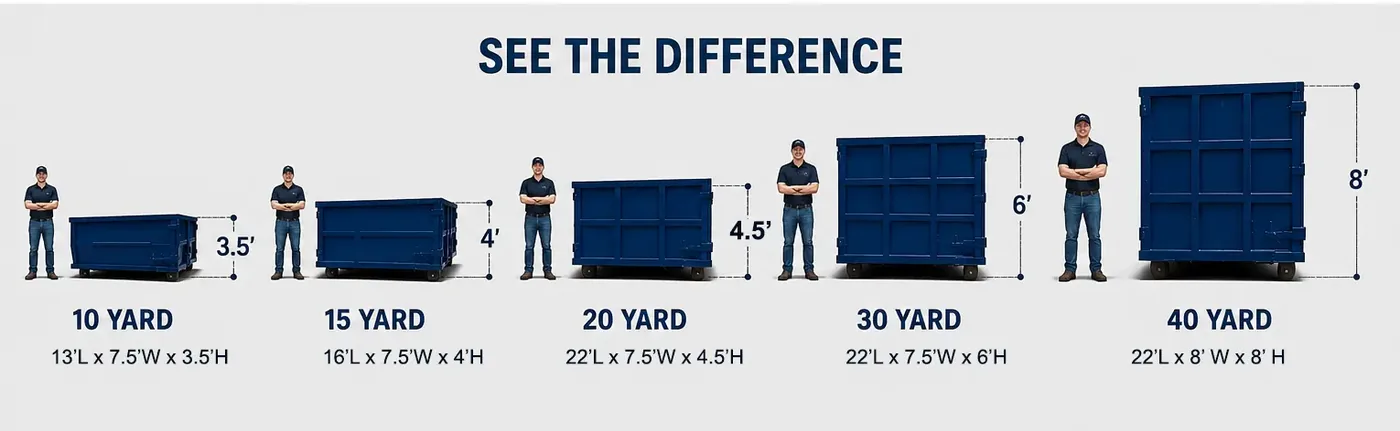
| Size | Typical Dimensions* | ~Trash Bags | Typical Uses |
|---|---|---|---|
| 10 Yard | ~13 ft L × 7.5 ft W × 3.5 ft H | 50–70 bags | Small cleanouts |
| 15 Yard | ~16 ft L × 7.5 ft W × 4 ft H | 75–105 bags | Roofing & medium cleanouts |
| 20 Yard | ~22 ft L × 7.5 ft W × 4.5 ft H | 100–140 bags | Remodels |
| 30 Yard | ~22 ft L × 7.5 ft W × 6 ft H | 150–210 bags | Construction |
| 40 Yard | ~22 ft L × 8 ft W × 8 ft H | 200–280 bags | Large demolition |
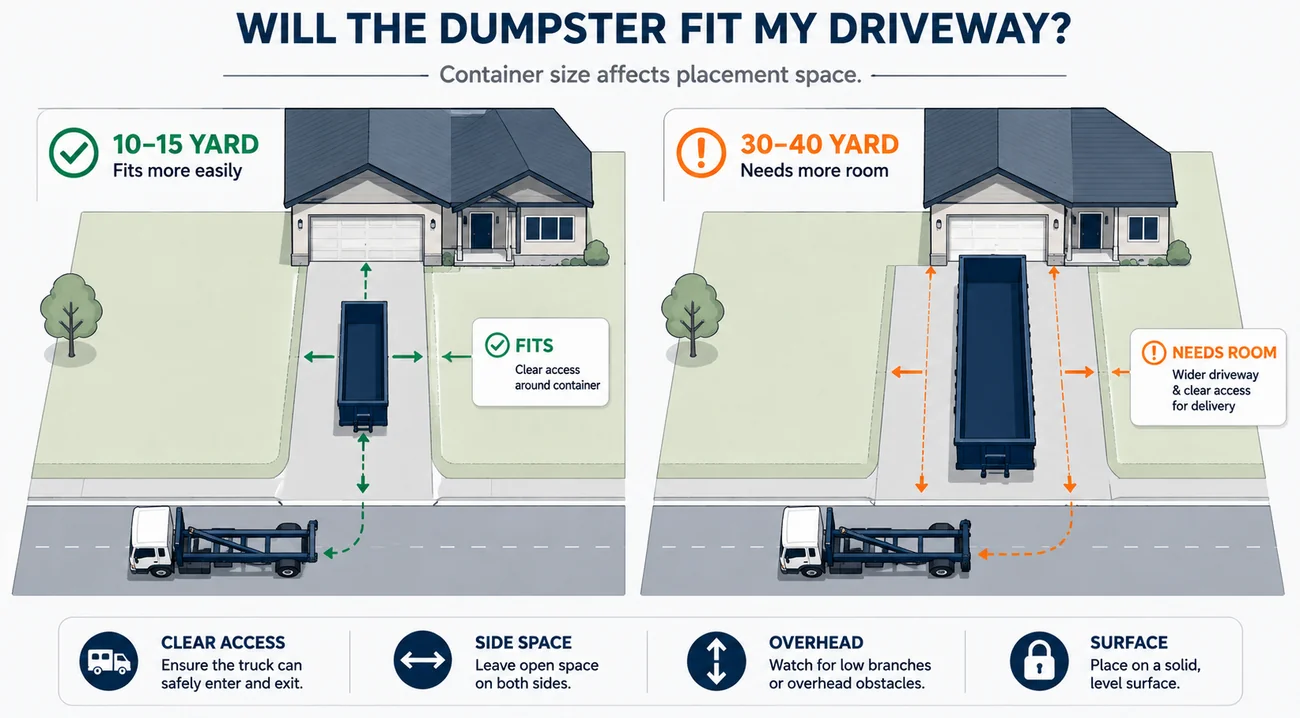
*Approximate — actual container dimensions vary by equipment and provider. Call before delivery if you need exact measurements for a tight driveway or gate.

Project type gets you close. These three checks narrow it down when your job sits between two sizes.
Very rough volume estimate — truck-bed sizes and how high you load them vary a lot.
Container size tells you the volume. Weight allowance tells you how much you can actually haul before an overage fee kicks in — and heavy debris hits that limit long before the container looks full.
So why does a 10-yard full of concrete run into its limit faster than a 30-yard full of old furniture? It comes down to density, not size — and it’s a common reason a rental runs into an overage charge.

These are ranges because the exact allowance depends on your rental terms — ask for your exact weight limit when you book, so you know the real number before delivery, not after. Going over it adds a per-ton charge — ask for that rate too, see the weight limits guide, or check our full pricing breakdown. If you’re loading a meaningful amount of concrete, dirt, or brick, mention it up front so we can size for weight, not volume. Overage charges are based on the actual landfill weight ticket, not a guess.
Project type gets you close, but the material you’re loading changes the math — dense debris hits the weight limit long before the container looks full. Use this chart to cross-check your size choice against what you’re actually throwing away.
Best fit: 10–30 yard. A 40-yard is overkill for furniture and boxes.
Best fit: 10–20 yard. Bulky but light — you’ll run out of room before you hit the weight limit.
Best fit: 15–40 yard. A 10-yard only makes sense for a small job.
Best fit: 15–20 yard. Shingles are dense — bigger containers rarely make sense for a roof alone.
Any size works, but only in limited quantities — this material is dramatically denser than household junk and hits the weight limit fast, often in much smaller quantities than you’d expect. This includes caliche, the hard, pale-gray soil layer common on Panhandle properties — it’s heavier than regular dirt, so budget weight accordingly.
Best fit: 15–30 yard. A 10-yard covers one room at a time.
Best fit: 30–40 yard. Anything smaller won’t hold a full structure tear-down.
Best fit: 40 yard. Smaller sizes aren’t enough for commercial-scale debris.
Concrete, brick, and dirt are dramatically denser than household junk by volume. A 10-yard fully loaded with concrete can weigh more than a fully loaded 30-yard of furniture and boxes — which is why every size accepts it only in limited quantities, regardless of container size. See our loading and weight guide for exact limits, or call before loading a large amount of any heavy debris.
Most single-room or garage cleanouts fit a 10-yard. A full home cleanout — furniture, boxes, years of accumulated stuff — usually needs a 15- or 20-yard, since this debris is bulky but light and fills by volume before weight becomes a factor.
A single-layer tear-off on an average Amarillo home usually fits a 15-yard. Multiple layers or a larger roof push that toward a 20-yard, since shingles are dense and hit the weight limit well before the container looks full.
A single bathroom remodel typically fits a 10-yard. A kitchen remodel, or a bathroom plus flooring and drywall, usually calls for a 15- or 20-yard depending on how much of the room is being torn out.
Weight decides this one, not volume. Concrete and dirt are typically subject to strict quantity and weight limits on any size, so going to a larger container doesn’t necessarily solve the problem — the weight allowance usually runs out long before the container looks full. Call with a rough count of wheelbarrows, buckets, or cubic feet and we’ll size it for weight, not guesswork.
When in doubt, call and describe the job; we’d rather size it right than sell you a bigger container you don’t need.
Dumpster demand here isn’t random — it tracks the kind of work happening in each part of town.
Hail and high wind push roofing demand across Georgia Street and the South Side (79109) — often for weeks after a bad system.
Wolflin (79102) and San Jacinto stay steady year-round. Narrower older drives often mean a 10- or 15-yard by default.
Growth near Tascosa Road and Loop 335 usually calls for a 30- or 40-yard — that’s the norm out there, not the exception.
Canyon (79015), Bushland, and the rest of Potter/Randall County: same sizing math, but gravel drives and gated access matter more.
Doesn’t fit neatly into this Amarillo dumpster size calculator? A remodel that turns into a partial demo, a cleanout with a shed’s worth of scrap metal mixed in — call and describe it. We size mixed jobs over the phone every day and would rather ask two extra questions than have you order the wrong container.
Not every project fits neatly into one category. Still not sure what size dumpster you need for a mixed-material job? Tell us about your project and we’ll recommend the right dumpster based on your debris, available space, and weight — without upselling you into a larger container.
Same-day delivery when you call before noon. Flat-rate pricing — no hidden fees, no fuel surcharges, no billing surprises. Your roll-off dumpster rental in Amarillo, TX, handled in one call.